Vdovichenko
Doctor ZhivagoVdovichenko, called Black Banner and described as a pillar of Russian anarchism, is a genial, dream-haunted presence among the Forest Brotherhood. His belief that civic institutions must grow from below, rather than be imposed from above, gives political form to his anarchism—and makes his execution a pointed contrast between revolutionary ideals and the violence used to enforce authority.
Identity and Presence
Vdovichenko is introduced in a crowded shed where a dozen or so people gather, some standing and others sitting on the floor. Unlike the silent, grim veterans of the 1905 revolution, he is in constant motion: sitting down and rising again, pacing, or stopping in the middle of the room. The narrator identifies him as an anarchist and describes him as a fat giant, with a large head and mouth and a lion’s mane of hair. He had served as an officer in a war, though the narrator is uncertain whether it was the war with Japan or the one with Turkey.
His imposing appearance does not make him an alert political operator. Vdovichenko is a dreamer, absorbed in fantasies, whose good nature and sheer size seem to blunt his attention to what is happening around him. He misunderstands events, mistakes his opponents’ views for his own, and agrees with people whose positions conflict. The contrast between his physical scale and his political inattention makes him less a calculating faction leader than a temperament: open-hearted, eccentric, and poorly suited to the tactical suspicion that governs the camp.
Political Beliefs and the Meeting
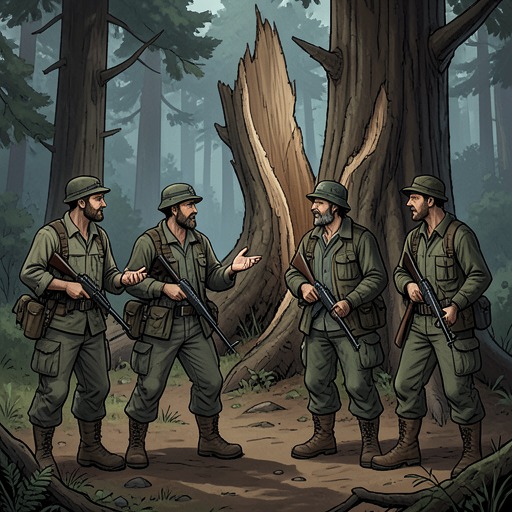
At the meeting, some speakers object to trusting military specialists, recalling that soldiers may include counterrevolutionary elements. As the discussion runs late and people repeatedly call for a resolution, Vdovichenko offers a different principle. Civic institutions, he argues, should be democratic and established from below, taking root like seedlings in soil; they cannot be hammered into place from above like fence stakes. He invokes the Jacobin dictatorship and the Convention’s destruction by the Thermidorians as a warning against imposed authority.
The image of seedlings is more than a decorative comparison: it defines his political distinction between organic growth and coercive construction. Institutions should arise through the participation of those who live under them, not be fixed in place by command. The argument also exposes the gap between an ideal of popular self-government and the meeting’s deteriorating deliberation. The crowd presses for a resolution and a return home, while the discussion becomes less coherent until it finally breaks up at dawn. Vdovichenko’s language offers a principle of consent, but the scene does not show that principle becoming a practical program.
Svirid, his friend and fellow vagabond, backs him up in plain, earthy terms. He says the group should have recognized the danger earlier, but now that they have begun the struggle they must press on rather than turn back; the soup has been cooked and must be eaten. Vdovichenko’s critique of imposed political forms thus sits beside Svirid’s fatalistic acceptance of the course already chosen. Their agreement is sincere, but it cannot undo the constraints of the conflict they are in.
Rivalry and Execution
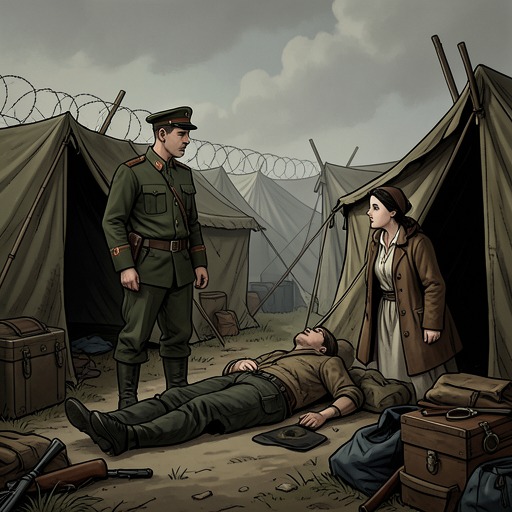
Vdovichenko’s influence within the camp becomes dangerous to Liberius. Svirid later reflects that Vdovichenko’s only crime was that his influence rivalled Liberius’s and brought dissension into the Forest Brotherhood. The political dispute is therefore not simply a disagreement over principles: influence itself has become a threat in a camp where power is concentrated and dissent is treated as a danger. Vdovichenko is shot, and Svirid understands the execution as the destruction of a rival rather than punishment for a clearly stated crime.
The scene of the condemned men’s deaths presents Vdovichenko as unchanged at the edge of the grave. With his head high and his gray hair streaming in the wind, he addresses Rzhanitsky as one anarchist speaking to another, loudly enough for everyone to hear. He warns that the new masters of execution will not understand Rzhanitsky’s protest, but insists that history will tell the truth and posterity will condemn the rulers’ deeds. He names their deaths martyrdom for their ideals at the dawn of world revolution and ends by calling for the revolution of the spirit and world anarchy.
His speech turns the execution into a public contest over who will define its meaning. The authorities can shoot the condemned, but Vdovichenko claims a longer judgment: history and posterity will distinguish revolutionary ideals from the acts committed in their name. The volley of twenty shots kills half the condemned men outright; a second salvo kills the rest. Terioshka Galuzin, a boy, twitches longest before falling still. The physical finality of the firing makes Vdovichenko’s appeal to future judgment both defiant and precarious: his words survive as an accusation, but they cannot save those who hear them.
Svirid and the Cost of Dissent
Vdovichenko’s death continues to shape the choices of Svirid, who is deeply shocked by the shooting. He longs to leave the partisans and return to his former private, independent life, but believes departure is impossible: having made his choice, he would be executed as a deserter if he left the Forest Brotherhood. His response makes the cost of Vdovichenko’s fate concrete. The camp’s coercion does not end with the shooting; it confines the living by making withdrawal punishable too.
Vdovichenko’s arc is brief, but its movement is clear: a distracted, good-natured anarchist articulates a politics of institutions rooted in popular consent, then becomes a target when his influence challenges the camp’s leader. His final insistence that history will tell the truth stands against both the firing squad’s immediate power and Svirid’s knowledge that he cannot simply walk away. The result is not a reconciliation between revolutionary ideals and revolutionary force, but a stark measure of how far the latter has displaced the former.